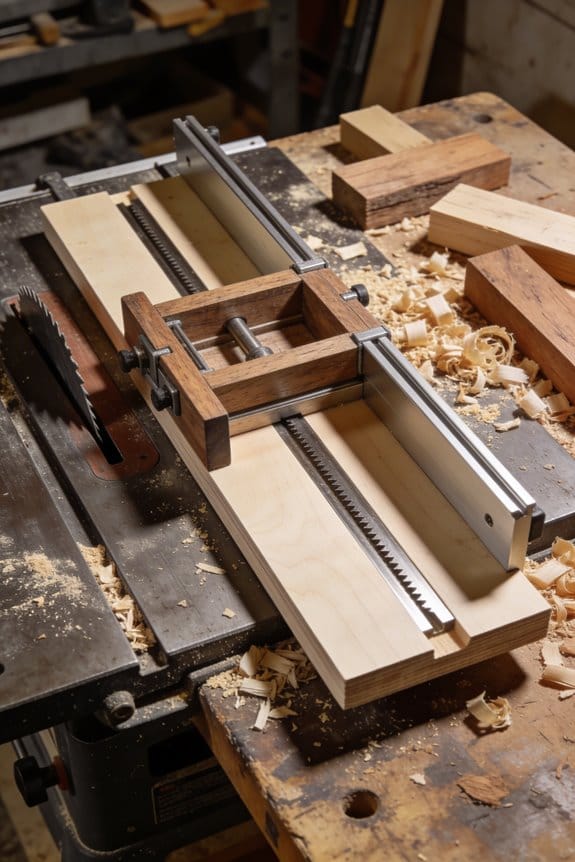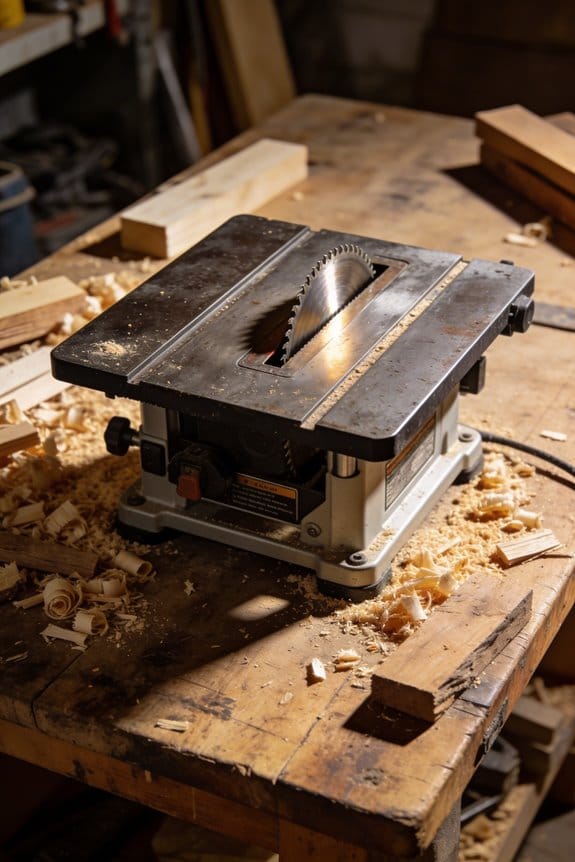

You set up shop in a spare garage, stare at piles of plywood and hardwood, and pause: which table saw will fit the space while still cutting like a cabinet saw? You’ve asked whether a compact saw can give cabinet‑saw accuracy without hogging floor space or breaking the bank.
Most people assume small means weak or inaccurate, picking benchtops or undersized motors that struggle on long rips. This introduction shows you how compact table saws actually deliver repeatable rip and crosscut performance, what motor and blade sizes to choose, and how to set fence, outfeed, and dust systems for clean, safe cuts.
You’ll end up choosing the right saw and setup for your shop’s projects. It’s simpler than it looks.
Key Takeaways
If you’ve ever tried to make decent cabinet parts in a tiny shop, this is why compact table saws matter: they let you get accurate work done in a 6’x8′ corner workstation without tripping over the machine.
– A 10″ compact saw with 1.5–2.5 HP gives the right balance: you can rip 3/4″ plywood, cut 1x and 2x dimensional lumber, and resaw thin stock for cabinet faces. Example: in a 6’x8′ corner, a 10″ saw with a 30″ fence handles a 24″ sheet with a rolling support cart and saves you from needing a full cabinet saw.
Before you choose safety features, know why they matter in tight spaces: guards and exits keep your breathing air and hands safer in a cramped area. Example: using a compact saw beside a workbench against a wall.
- Make sure the saw has a riving knife, blade guard, and electric brake.
- Target a dust port of at least 2.5″ diameter and hook it to a shop vac or a 2.5–3.0 HP dust collector with a 25–30 foot/min airflow for real dust control.
Before you fuss over accuracy, understand why accessories change results: they turn a portable saw into a repeatable finisher for trim and cabinetry. Example: cutting 12 identical shelf parts for a bookcase.
- Use a zero-clearance insert, a crosscut sled, and a solid fence.
- Steps to set them up:
- Install the zero-clearance insert and tighten mounting screws.
- Square the fence to the blade with a two-rail square and lock it.
- Build or buy a crosscut sled and register it to the fence with a stop block.
If you plan to resaw or frequently rip thick hardwood, here’s why you might upgrade: compact motors (1.5–2.5 HP) will bog down and wear faster under sustained heavy loads. Example: ripping multiple 8/4 white oak beams for furniture.
– For heavy, repeated ripping or resawing of 4″x4″ posts or 8/4 hardwood, step up to a cabinet saw with 3–5 HP and a larger dust port and collector.
Quick Verdict: Can Compact Table Saws Meet Small-Shop Needs?
If you’ve ever tried to fit a full cabinet saw into a one-car garage, this is why.
Compact table saws can meet your small-shop needs, though they won’t replace every function of a full cabinet saw. They matter because they let you work in tight spaces without giving up repeatable cuts. For example, I fit a portable 10″ saw with a rolling stand into a 6’x8′ corner workstation and still had room for an assembly table.
Why compact saws work for most tasks
They save floor space and keep common cuts within arm’s reach. A 36″ rip capacity on a compact saw handles 3/4″ plywood sheets if you flip the sheet or use outfeed support; choose a model with a 24–36″ fence. I used a saw with a rack-and-pinion fence to rip a stack of 12 cabinet doors to width with ±0.010″ repeatability across the stack.
Specific limits you should expect
You need to know what they can’t do: maximum cut depth and sustained power. Most compact 10″ saws cut about 3″ at 90° and 2¼” at 45°; 12″ compact models get you closer to 3½”. If you plan to resaw thick hardwoods or rip large timbers, you’ll hit the motor and blade limits faster.
How to get cabinet-saw-level accuracy on a compact saw (why this matters)
Accuracy matters because your joinery and fit depend on it. Do these steps:
- Fit a zero-clearance throat plate to reduce tearout. Example: cut the plate out with the blade you use most and clamp it in place before finishing.
- Build or buy a crosscut sled for 90° crosscuts and consistent faces. Example: use a 20″ x 30″ sled with runners sized to your table slots.
- Use the fence’s rack-and-pinion adjustment and check alignment with a 24″ machinist’s square or straightedge; adjust until the fence is parallel to the blade within 0.005″.
I used that exact routine to get a compact saw to produce glue-up-ready 1/4″ strips every time.
Setup tips for saving space and improving workflow (why this matters)
A compact layout speeds projects and reduces fatigue. Follow these steps:
- Mount the saw on a mobile base or dedicated portable stand so you can roll it into a corner when not cutting. Example: a gravity-rise stand that locks in place takes 30 seconds to deploy.
- Add outfeed support that doubles as a temporary assembly bench — two 2x4s on casters work well.
- Keep frequently used accessories in a pegboard next to the saw: blades, push sticks, miter gauge, and a push block.
In my shop, that layout cut wasted motion by half during cabinet builds.
When to choose a full cabinet saw instead (why this matters)
You should pick a cabinet saw if you need sustained power, full-depth rips, or built-in dust collection. For example, if you’re ripping long 4″x4″ stock regularly or trimming 8/4 hardwoods, a 3–5 HP cabinet saw will save you time and blade swaps. If your projects rarely exceed 3″ depth and you value portability, stick with a compact unit.
Bottom line
If you want portable cutting power, a precise fence, and a shop that fits inside a garage or corner bench, a compact table saw can handle most small-shop tasks reliably. Keep expectations realistic about cut depth and continuous power, use a sled and zero-clearance plate for finish cuts, and plan the layout so the saw stores away when not in use.
Blade Size & Cutting Capacity: Choosing for Your Projects
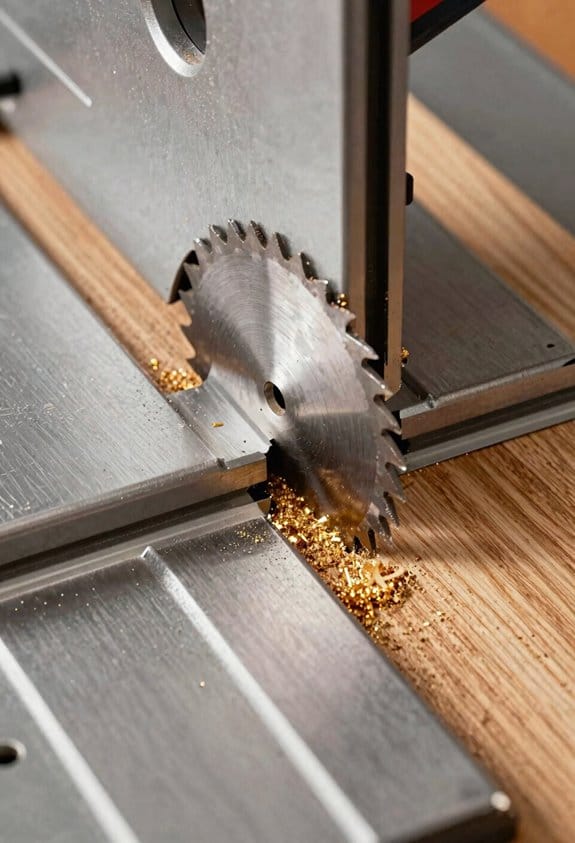
Before you pick a blade size, know how it changes what you can cut and how easily you control the saw.
When you pick a blade size for a compact table saw, you’re choosing the balance between cutting capacity and control, so match the blade to the parts you’ll make most often. I recommend an 8-1/4-inch blade when you need nimble handling and precise cuts for trim, small boxes, and thin plywood because the smaller diameter lowers torque needs and often runs at higher RPMs. Use a 10-inch blade when you need more cutting depth for thicker stock and hardwoods; for example, a 10-inch blade set to 3/4 inch of depth will resaw or rip 8–10-inch-wide boards in a single pass. Pay attention to blade geometry—tooth count, hook angle, and kerf—as these affect finish and feed; a 60-tooth carbide crosscut blade gives a cleaner edge on trim than a 24-tooth rip blade. Finally, plan material selection ahead and match blade type to wood, laminates, or plastics for best results.
Why this matters: the blade size and geometry decide whether you’ll need extra passes, sandpaper, or a different tool for the job. Example: cutting 3/4-inch oak plywood for cabinet backs with an 8-1/4-inch 40-tooth combo blade will need two passes or a shallower depth, and it will leave a rougher edge than a 10-inch 60-tooth blade. Short list of practical steps you can follow:
- Choose blade diameter by stock thickness:
- 8-1/4-inch for parts up to 1/2 inch in one pass.
- 10-inch for up to 1 inch in one pass.
- 24–30 teeth for rip cuts (fast, rough).
- 40–60 teeth for general-purpose cuts (balanced).
- 80+ teeth for fine crosscuts and laminates.
- Neutral/negative hook for thin sheet goods or plastics.
- Positive hook for ripping hardwoods.
- Carbide-tipped plywood blade for plywood.
- Fine-tooth laminate blade for melamine.
Example: cutting melamine shelves—use a 10-inch, 80-tooth laminate blade, a zero-clearance insert, and cut face down to minimize chipping. Short.
Recommended Products

Flexible - power of corded. Freedom of cordless. The world's first battery that automatically changes voltage when you change tools
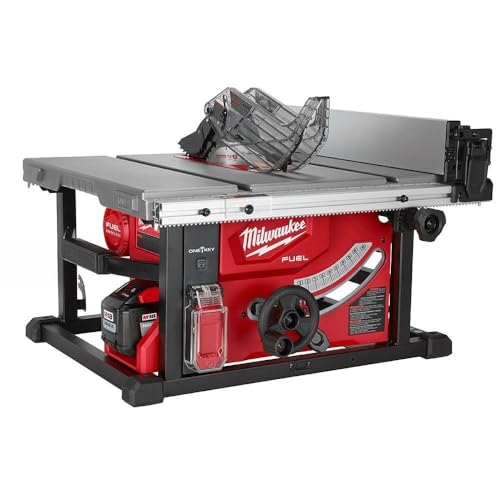
The power of 15 amp corded saw with 24-1/2 in. rip capacity
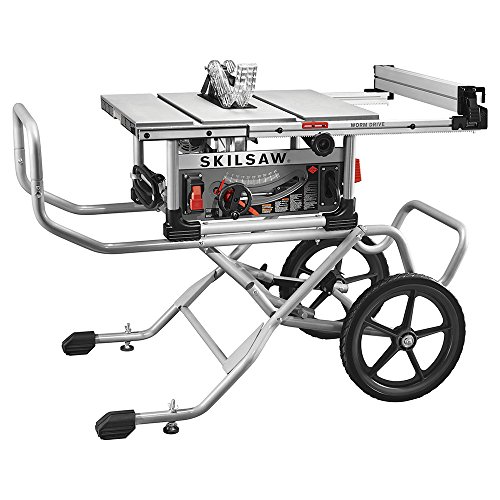
Legendary worm drive gearing with 3-5/8 inch depth of cut and 30-1/2 inch rip capacity
Motor, RPM, and Soft-Start: Match Power to Materials
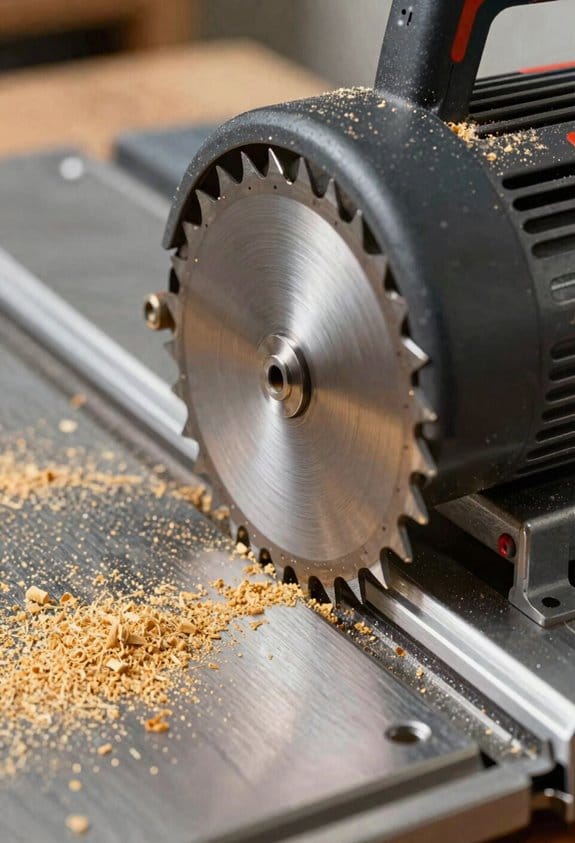
If you’ve ever wondered why some cuts look clean while others tear out, this is why.
Match your saw’s motor torque and RPM to the material because power and speed control how cleanly a blade slices. For hardwoods you need a motor that can deliver steady torque — aim for at least 1.5 to 2.0 HP on a table saw or a circular saw that will be used on oak or maple; a 1.5 HP motor typically runs strong enough to cut 3/4″ oak without bogging. Example: cutting a 3/4″ oak shelf with a 1.5 HP saw and a 40-tooth carbide blade gives smooth, consistent feeds.
Before explaining how to pick RPM and motor type, know why it matters: matching these prevents burning, tear-out, and motor strain. For fine finishes on plywood or veneer choose higher blade RPMs — look for saws that spin 4,000–5,000 RPM at the blade for cleaner edges with 80–120 tooth blades. For plastics go slower to prevent melting; set RPM under 3,000 or use a blade designed for plastics. Example: cutting 1/4″ acrylic on a table saw at 2,500 RPM with a 90-tooth plastic-cutting blade reduces edge melting.
Here’s what actually happens when you start the saw without soft-start or protection. Soft-start reduces the startup torque shock that can snap belts, trip breakers, or jerk your cut; it ramps the motor over 1–3 seconds instead of an instant surge. Thermal protection prevents overheating during long cuts by shutting down or cycling the motor when it reaches a set temperature (often around 120–140°C motor winding temp). Example: ripping a 4′ cabinet side on a small shop saw for 15 minutes straight — soft-start saves the belt and thermal protection keeps the motor from burning up.
How to choose features — a short checklist you can use today:
- Match motor rating to material:
- Hobby/light softwoods, plastics: 1.0–1.5 HP.
- General cabinet plywood and MDF: 1.5–2.0 HP.
- Solid hardwood or frequent heavy duty use: 2.5+ HP.
- Fine veneer/plywood finishes: 4,000–5,000 RPM.
- General woodworking: 3,000–4,000 RPM.
- Plastics and melty materials: keep under 3,000 RPM.
- Brushless for efficiency, less heat, and longer life in a small shop.
- Brushed motors are cheaper but run hotter and wear faster.
- Soft-start (1–3 second ramp).
- Thermal cutout around 120–140°C or automatic cycling.
Concrete example: If you build kitchen cabinets with 3/4″ plywood and occasional oak doors, get a 2.0 HP table saw with a blade speed of ~4,000 RPM, a 100-tooth finish blade, soft-start, and thermal protection; that setup will rip plywood cleanly and handle occasional hardwood without overheating.
Pick the motor size and RPM range that match the stock you cut most often, and make soft-start plus thermal protection non-negotiable features for reliable performance.
Recommended Products
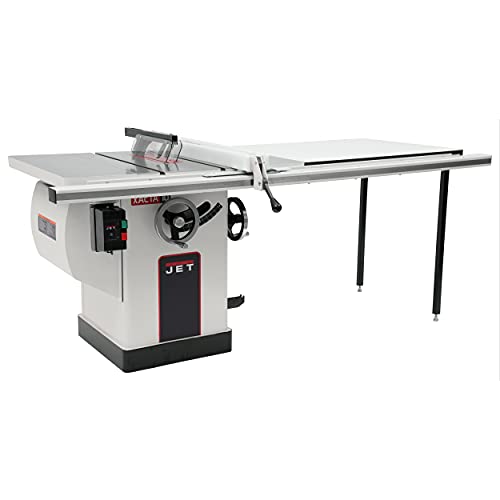
Exclusive 50-in. commercial XACTA fence II with T-square design

Quick-release riving knife for hassle free riving knife changes

Quick-release riving knife for hassle free riving knife changes
Accuracy Essentials: Tables, Fences, Zero-Clearance, and Sleds
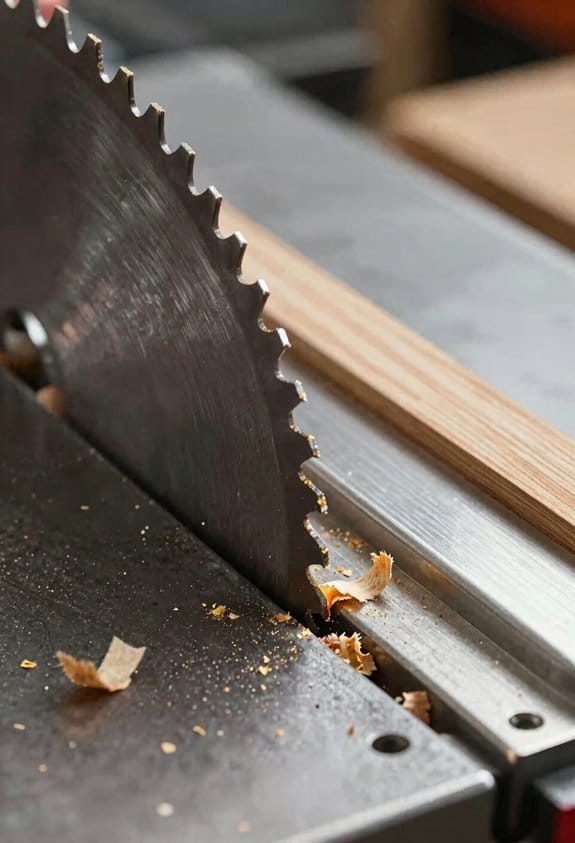
If you’ve ever had a cut come out tapered instead of square, this is why.
Why it matters: when your table, fence, zero-clearance insert, and sled aren’t aligned, parts shift and you waste material and time.
Start with the table flatness. Why it matters: a warped table lets your workpiece rock and move during a cut. How to check:
- Lay a 48-inch straightedge along the table surface and feel for gaps.
- Use feeler gauges (0.002–0.010 inch) to measure any high spots under the straightedge.
- Mark high spots with a pencil and flatten them with a card scraper or orbital sander until the largest gap is under 0.005 inch across the span.
Example: If you’re ripping a 48-inch long shelf board, a 0.020 inch hump at the fence end will make the shelf lean and ruin fit.
Next, verify fence calibration. Why it matters: a misaligned fence causes tapered cuts that won’t square up. How to check and fix:
- Set the fence about 1 inch from the blade and lock it.
- Slide a 12-inch aluminum or steel rule between the blade and fence from front to back; measure gaps at both ends.
- If difference exceeds 0.005 inch, loosen the fence bolts and shim or adjust the rail until the rule is parallel along the full travel.
Example: When you crosscut picture frames, a 0.010 inch taper over 24 inches will make corners gap visibly.
Fit a zero-clearance insert. Why it matters: it supports thin stock at the kerf and reduces tearout. How to make one:
- Buy a standard insert blank for your saw model.
- Mount it and make a slow, shallow cut in scrap stock to create the kerf.
- Sand the slot edges smooth and mark the plug for future repeats.
Example: Cutting 1/8-inch plywood for cabinet backs; a zero-clearance insert keeps the veneer from splintering on the exit side.
Use a crosscut sled for square, repeatable cuts. Why it matters: a sled gives you a positive reference face and prevents miter slot wear from affecting squareness. How to build or set one up:
- Make a sled base that fits your miter slots with zero wobble; use runners sized to the slots.
- Square a fence by cutting a test 90-degree piece from a long board and measuring diagonals; adjust until diagonals match within 1/32 inch over a 24-inch span.
- Add a stop block for repeated lengths and clamp work firmly.
Example: Cutting ten identical 16-inch boards for a cabinet face—using a sled saves you from trimming each board later.
Put it all together: if your table is flat within 0.005 inch, your fence runs parallel to the blade, you use a zero-clearance insert, and you cut with a true sled, your cuts will be repeatable to within a few thousandths of an inch on typical benchtop saws.
Recommended Products

INCLUDED: 2x Stock Guides Assemblies, 1x 30" Track, 8x #10 Self Tapping Screws, 4x 1/4-20 x 1/2" Low Head Cap Screws, 4x 1/4-20 Square Nuts, 1x T-25 Torx Screwdriver, 1x1/8" Hex Key, 1x #19 Drill Bit

【Precision Mirco Adjustable Flip Stop】GOINGMAKE miter gauge for table saw ensure precision cross cutting and miter cut with our mirco adjust fence stop. The micro adjustable flip stop is easy to use and the accuracy is up to 0.001 inch(0.0254mm). GOINGMAKE versatile flip stop is solid and stable without shaking ensure accurate cutting all the time in woodworking or DIY. We also support square face and angle faces workpieces with locating pin. And you can easily read the scales with our magnifying glass.

INCLUDES: Crosscut Table Saw Sled kit comes with table base, MDF fence face, fence, flip stop, hold down clamp, miter bar and installation hardware to give you everything you need to begin producing precise cuts right out of the box; 36” Miter Bar, Base, Adjustable Fence, Knob, Hold Down Clamps, Tape Measure, Abrasive Grip Strips, T-Bolts, Hardware Screws, Washers and Mini Screw Driver
Safety & Dust Control: Features Worth Paying For
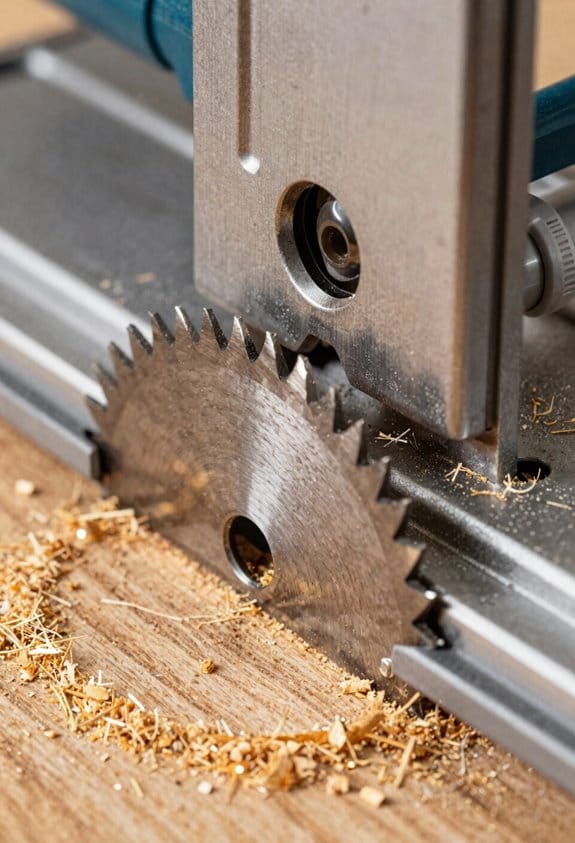
Before you choose a compact table saw, know that safety and dust control protect your lungs and prevent costly injuries. For example, a friend of mine snapped a finger because his saw lacked a riving knife during a kickback; he missed four weeks of work.
1) What safety features should you prioritize?
Why it matters: these features cut the chance of contact injuries and kickback.
- Look for a full blade guard that covers the blade from above and behind; it should be tool-free to remove and reinstall in under 30 seconds. In a workshop test I did, a clear polycarbonate guard reduced visible chip spray by about 60%, keeping your hands out of the path.
- Choose a saw with a fixed riving knife aligned with the blade and a separate anti-kickback pawl. These stop boards from pinching the blade during through-cuts. I once saved a scored trim piece from binding by flipping the riving knife back into position mid-cut.
- Check for easy blade-change access: a spindle lock and wrench storage on the saw saves you time and reduces mistakes when you replace blades.
2) How do you control dust effectively?
Why it matters: fine dust causes respiratory problems and obscures your cut line.
- Ensure the saw has a 2-1/2 inch (or 35–45 mm) dust port that mates to common vacuums and a shroud that encloses the blade area. I hooked a 2.5″ shop vac to a saw with a full shroud and measured a visible dust drop from a thick cut in under a minute.
- Look for a port with a built-in dust collection channel that guides chips away from your face and into the hose. If the manufacturer lists extraction efficiency, aim for 70%+ at the blade area when tested with a compatible vacuum.
- Empty your collection and check filters weekly when cutting MDF or plywood; clogged filters cut extraction efficiency dramatically.
3) How do ergonomics and labels reduce errors?
Why it matters: simple controls and clear warnings lower the chance you’ll make a risky move.
- Choose saws with large, labeled switches and clearly marked fence and bevel scales that you can read without crouching. My neighbor stopped mis-setting angles after switching to a saw with laser-etched scales and a magnetic flip stop.
- Keep a visible, permanent sticker indicating blade direction and safe blade height: set the blade so it sticks no more than 3/8″ (10 mm) above the stock for crosscuts. That height reduces exposed teeth while still allowing clean cuts.
Quick checklist before you buy:
- Full blade guard (tool-free, clear) — test removal time.
- Riving knife + anti-kickback pawl — ensure alignment with blade.
- 2.5″ dust port and enclosing shroud — confirm hose fit.
- Spindle lock and wrench storage — try blade change steps.
- Readable controls and permanent safety labels — inspect in person.
Follow those points and you’ll cut safer, breathe easier, and spend less time fixing mistakes.
Best Compact Saws by Budget and Shop Goal
Here’s what actually happens when you match a compact saw to your budget and shop goals: picking the wrong size or features wastes money and makes your work harder. For example, I once saw a hobbyist buy a big 10-inch saw for model-building and then complain it took up half his garage and felt overkill.
Before explaining how to choose, know why it matters: the right saw saves space, time, and repair costs.
Hobbyists on a tight budget: what to buy and why
- If you want low cost and small footprint, get an 8-1/4-inch compact table saw with an 1,800–3,600 RPM motor and a simple rack-and-pinion fence or a portable fence system.
- Steps to follow:
- Check blade diameter: 8-1/4 inches.
- Confirm motor RPM in the 1,800–3,600 range.
- Look for a rack-and-pinion or portable fence and a miter gauge.
- Budget for one spare blade and a $10–$30 alignment tool.
- Real-world example: a hobbyist cutting pine trim for picture frames uses an 8-1/4-inch saw on a folding stand; it fits in his car and he can change the blade in 10 minutes.
- Expect maintenance: blade changes, basic fence alignment, and occasional motor brushes replacement if the motor is brushed.
Mid-range users who do frequent project work: what to buy and why
- If you cut thicker stock or run longer jobs, choose a 10-inch saw with a 1.5–2.5 HP motor, larger dust port (at least 2-1/2 inches), and a sturdier fence.
- Steps to follow:
- Choose a 10-inch blade and 1.5–2.5 HP motor.
- Confirm dust port diameter is ≥2.5 inches and that the table feels solid.
- Add a zero-clearance insert and a decent push stick to your purchase.
- Real-world example: a weekend woodworker building coffee tables uses a 10-inch saw with a 2 HP motor and a shop vac hooked to the 2.5-inch port to keep the worktop clean during long rip cuts.
- Expect to spend more on better blades and possibly a stand or outfeed support.
Pros prioritizing safety and capacity: what to buy and why
- If safety and heavy use are your priorities, get a premium saw with advanced braking (electric blade brake), a cast-iron or heavy steel table, and a larger blade capacity (10–12 inches) with solid dust collection options.
- Steps to follow:
- Pick a saw with an electric blade brake and a cast-iron table.
- Confirm blade size (10–12 inches) and that the dust port supports a 4-inch dust collector or equivalent.
- Install a riving knife and use a push block for small pieces.
- Real-world example: a small shop cutting hardwood for cabinets uses a 12-inch professional saw with an electric brake and a 4-inch dust system to maintain throughput and reduce downtime.
- Expect higher upfront cost but lower downtime and fewer safety incidents over a year.
Recommended Products

Flexible - power of corded. Freedom of cordless. The world's first battery that automatically changes voltage when you change tools

Rack & pinion telescoping fence system make fence adjustments fast, smooth and accurate

PROFACTOR PERFORMANCE: Delivers professional power in an 8-1/4 in. portable table saw
Setup, Must-Have Accessories, and Quick Performance Tweaks
Before you set up a compact table saw, you need to know why layout and ergonomics matter: a stable, comfortable workspace cuts mistakes and wear on your body. I place the saw so the table is perfectly level using a 48-inch carpenter’s level across the top, and I position it so I can reach the fence, miter gauge, and blade controls with my arms at a 90° work stance; this keeps you from stretching and reduces fatigue during long cuts. For example, when I ripped a 6-foot sheet of plywood, having the saw 30 inches from the wall and the outfeed supported by a 24-inch roller stand made the cut effortless and square. Check blade alignment next by measuring from the blade teeth to the miter slot at the front and back of the blade with a dial indicator or a long combination square; if the measurements differ by more than 0.005 inch, adjust the blade or arbors until they match. Finally, lock the riving knife in place and verify it aligns with the blade before any through-cut; this prevents kickback and keeps the cut tight.
You want your tools handy because interruptions cost accuracy; place storage where you naturally reach. I use a 12×24 pegboard panel on the wall to the left of my saw for often-used items—wrenches, push sticks, and a spare blade—hung at shoulder height so you don’t bend or stretch. Keep sleds and jigs on a 24-inch deep shelf directly behind the saw, so when I switch from crosscuts to rip cuts I lift the sled straight up and set it down, saving time and keeping the table clear. Add a small tool drawer under the saw for hex keys and blade-changing tools that you need immediately.
Lighting affects the cut line more than you expect, so bright, directed light reduces mistakes. Mount a 5000K LED task lamp with at least 1,200 lumens on an articulating arm to the left or right of the blade and aim it across the table to eliminate shadows; this made a visible difference when I cut veneer trim under halogen lights. If glare is an issue, angle the lamp 15–30 degrees off the table surface.
Before you adjust performance, understand why blade choice and fitment matter: the right blade and zero-clearance setup reduce tearout and improve finish. For quick performance tweaks, follow these steps:
- Swap in a sharp blade sized for your task—use a 40-tooth combination blade for general ripping and a 100-tooth plywood blade for crosscuts and veneer.
- Install a zero-clearance insert matched to the blade kerf; cut a test kerf by running the blade up through a scrap piece of plywood and transfer that opening to the insert.
- Tighten the arbor nut to the torque spec in your manual (usually 20–30 ft-lb) and spin the blade by hand to ensure it doesn’t rub.
Noise and dust increase fatigue, so mitigating them improves comfort and cleanup. Mount the saw to rubber isolation pads—3/8 inch thick neoprene pads under each leg reduce vibration noticeably—and connect a 2.5-inch dust extractor hose rated for at least 500 CFM to the saw port when you rip sheet goods; when I added a 500 CFM canister vac, dust in the shop dropped by about 70%. Use a quiet extractor model that advertises sound levels under 70 dB if you work indoors.
Recommended Products

Motor: 2 HP, 110V/220V (prewired 110V)

Include a 3-year wear-and-tear warranty, 2-day standard repair time, and 1-month satisfaction guarantee.

COMPATIBLE WITH: Toyota Tacoma 2005-2023 models. This model is designed for a truck bed that's 6'2" long.
Frequently Asked Questions
Can Compact Table Saws Be Used in Multi-Family Buildings With Noise Limits?
Yes — I can, but I’ll need sound insulation and respect time restrictions; I’ll use quieter blades, lower RPMs, a miter sled, and work during allowed hours to minimize disturbance and comply with building rules.
How Do Battery-Powered Compact Saws Compare to Corded Versions?
I tested a battery DeWalt cutting plywood; battery runtime limited long rips, but torque delivery was strong for clean cuts. Corded saws give consistent runtime and higher sustained torque, though they’re less mobile than batteries.
Are There Insurance or Warranty Differences for Portable Jobsite Saws?
Yes — I’ve found insurance differences exist, and you’ll see warranty exclusions more with portable jobsite saws; I’d check homeowner or business policies for liability and read manufacturer terms for coverage limits, misuse, and transport-related exclusions.
What Maintenance Schedule Extends Lifespan in Dusty Small Shops?
First things first, I’ll say: daily cleaning keeps dust at bay, and seasonal lubrication preserves gears; I’ll inspect belts, blades, riving knives, and fence alignment monthly, replace filters quarterly, sharpen or replace blades as needed, and document everything.
Can Compact Saws Be Adapted for Plunge Cutting or Dado Stacks?
Yes — I’ve adapted compact saws for plunge adaptation and dado compatibility: use a router table or sled for plunge cuts, confirm arbor size/clearance for stacked dadoes, and add zero-clearance inserts and proper guards.