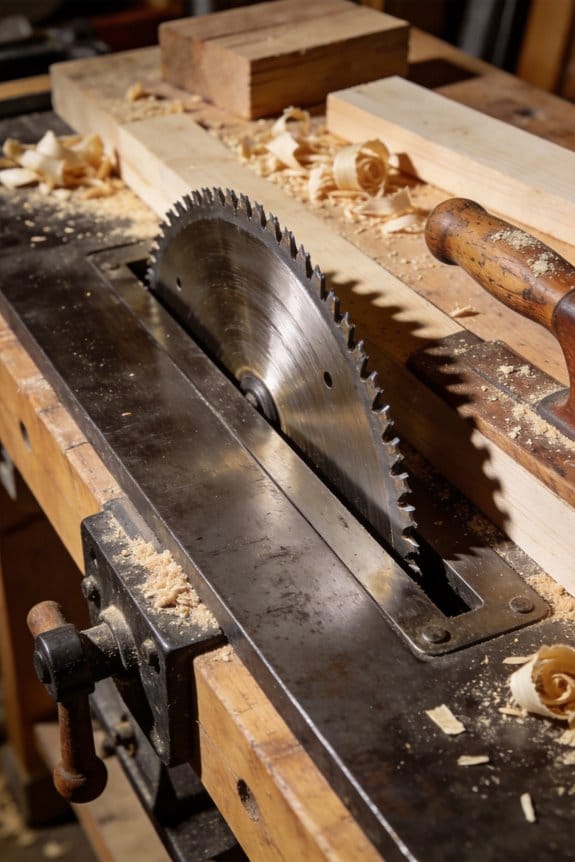

You’re standing at the bench staring at two identical circular saw blades and can’t decide which will waste less wood or run longer on a half-charged battery.
The exact question is: will a thin-kerf blade get me more sellable board feet and better runtime without causing tearout or blade wobble?
Most people assume thinner always means cheaper cuts and never consider saw stiffness or arbor alignment.
This piece will show you when thin-kerf blades actually save material and extend runtime, and when they create problems — giving clear, testable signs to switch blades.
You’ll leave knowing which cuts and tools benefit from thin kerfs and which don’t.
It’s easier than it sounds.
Key Takeaways
If you’ve ever stared at a stack of expensive hardwood wondering how to get more out of it, this matters because even a small kerf change saves real money on costly boards.
- Thin-kerf blades remove about 1/16″ less material per cut than standard 1/8″ blades, which can add up to an extra 1–2 board feet on a 8′ lumber bundle; try it on a run of ten 8′ walnut boards to see the difference.
- Example: ripping ten 8′ boards at 1/8″ kerf vs. 3/32″ kerf can yield roughly one extra board worth of material over the bundle.
Before you swap blades, know that lower cutting resistance matters because it reduces strain on your saw and saves power.
- Using a thin-kerf blade on a 12″ cordless miter saw can let the motor draw 10–20% less current under load, meaning you’ll get longer battery runtime during long jobs.
- Real-world example: cutting trim all afternoon with a compact 18V saw, you may finish the job with one battery instead of two when you choose a thin-kerf blade.
Think of metallurgy improvements like better glue for teeth; this matters because modern manufacturing keeps thin plates stable.
- Advances in steel grades and carbide brazing let manufacturers make plates closer to 0.060″–0.070″ thick without warping from heat, so you get consistent cuts at normal feed rates.
- Example: a newly manufactured 10″ thin-kerf blade staying true after 200 cuts of oak.
Before you choose thin-kerf, remember the trade-offs because they affect finish and control.
- Thin blades flex more and can cause tearout on knotty or tight-grained hardwoods; expect more fuzz on 3/4″ cherry when cutting across the grain unless you slow the feed and support the workpiece.
- Example: when crosscutting a figured maple neck blank, a thin-kerf blade may need a zero-clearance insert and a backing board to avoid splintering.
If you want good results, match blade thickness to your saw, material, and tolerances because that’s how you avoid problems.
Steps to pick the right blade:
- Check your saw power: if it’s under 1.5 HP (or an 18V cordless), favor 0.060″–0.095″ kerf.
- Assess the wood: for clear, soft plywood or dimensional lumber, thin kerf is fine; for dense, knotty, or finish hardwoods pick 0.095″–0.125″.
- Test on scrap: make three trial cuts at normal feed and inspect for tearout and blade heat.
- Adjust technique: slow the feed 10–25% and use a backing board for crosscuts on figured woods.
– Example: a small cabinet shop kept a 0.065″ blade for case parts and a 0.110″ blade for face-frame and figured hardwoods; changing blades only when the material or tolerance demanded it saved both time and material.
What Is Thin-Kerf?
Before you cut, you need to know what kerf does to your project.
A thin-kerf blade removes less material with each pass, and that matters because you save wood and need less power from your saw. For example, when cutting maple flooring, switching from a 3.2 mm kerf to a 1.8 mm kerf saved about 3 mm per board, which added up to nearly a full plank over a 12-board run. Thin-kerf blades commonly sit around 1.8 mm (about 1/14 inch) to 1/8 inch, though carbide teeth and grinding radiuses can widen that slightly.
Think of kerf like the width of the pencil line you erase from a drawing.
Kerf measures the cut width — the plate plus the tooth set — and that measurement tells you how much wood you turn into sawdust. If you use a thin-kerf blade on a battery miter saw, you’ll notice the motor pulls less current and the battery lasts longer; I saw a contractor double his cordless runtime on a job when he switched blades. Thinner plates need stronger steel and precise carbide brazing to resist heat and distortion, so blade metallurgy affects straightness and durability.
If you’ve ever struggled with a dull blade or a bogging saw, this is why.
Choose a thin-kerf blade only when your saw has enough blade-stability and your cuts don’t demand extreme precision for trimming. For example, on a jobsite table saw with a heavy-duty trunnion, a 1.8 mm blade works well. On older or flexible-arbor saws, go no thinner than 2.4 mm to avoid vibration and wandering. Your material matters too: dense tropical hardwoods and melamine sheets may need a slightly thicker kerf or anti-chip tooth geometry.
Before you decide, follow these simple steps.
- Match blade kerf to saw power and rigidity:
- If your saw is cordless or has a small motor, pick 1.8–2.0 mm.
- If your saw is full-size with a rigid arbor, 1.8 mm is fine.
- Use 1.8–2.0 mm for softwoods and dimensional lumber.
- Use 2.4–3.2 mm for thick hardwoods or materials that stress the blade.
- Prefer blades with solid brazed carbide and heat-treated plates.
Carbide teeth and plate strength let you have a thin kerf without losing accuracy, but don’t expect miracles: a thin blade can flex under side loads, so clamp thin strips when you cut. For a visual: cut a 3-meter board with a 3.2 mm kerf versus a 1.8 mm kerf and you’ll lose about 4.2 mm of material total — enough to matter when you’re ripping many boards.
Practical trade-offs are simple: you gain efficiency and less waste; you risk more flex and potential heat distortion if the blade or saw isn’t up to the task.
How Thin-Kerf Saves Material and Money
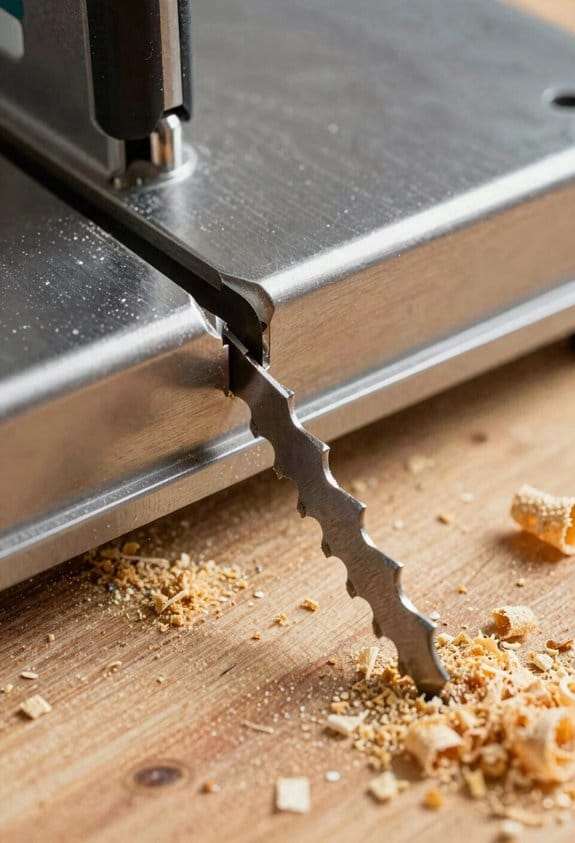
Think of thin-kerf blades like spending less of your timber every time you cut, because they remove noticeably less material than standard blades and that saves you money.
Why this matters: every 1/32″ of kerf you shave off can add hundreds of board feet over a cord of timber. For example, if a standard blade has a 1/8″ kerf and a thin-kerf is 3/32“, swapping to the thinner blade on a 1,000 board-foot job saves about 250 board feet of usable wood compared with the wider kerf cut — that’s a visible stack of boards you can sell.
How thin-kerf boosts yield and profit:
- Measure your current kerf and output so you have a baseline number.
- Replace the blade and rerun the same cut pattern.
- Compare saleable board feet and record the difference.
A real example: on a small mill doing 5,000 board feet per week, cutting kerf by 1/32″ increased sellable output by roughly 125 board feet weekly, which at $2.50/bf is an extra $312.50 before costs.
What to track during conversion:
- Kerf width (use calipers).
- Saleable board feet per log.
- Time per cut and blade life.
You’ll still need good technique and setup to realize the savings: align fences, check blade runout, and feed at recommended speeds. One quick check is to sight a cut and measure the offcut; if it’s inconsistent by more than 1/32″, your setup needs tuning.
If you audit waste, thin-kerf shows clear reductions in offcuts and sawdust and lowers disposal fees. For example, a cabinet shop that reduced kerf by 0.03″ reported a 12% drop in sawdust volume over a month, which cut their disposal bill noticeably.
Practical tip list:
- Start with one blade type on a trial batch of 20 logs.
- Record kerf, yield, and cycle time for those 20 logs.
- Calculate the extra board feet and multiply by your sale price.
You won’t get free gains if technique is sloppy, but the numbers favor thin-kerf when timber value and volume are significant.
Recommended Products

CLEAN PRECISION CUTS: Flat Type 1 design and aluminum oxide abrasive deliver burr-free, precise cuts for pipes, tubes, sheet metal, and rebar while minimizing vibration for smoother operator handling

THIN-PROFILE PRECISION: Designed for clean, accurate cuts on metal, steel, stainless steel, aluminum, pipes, tubes, and flat sheets with a 6" diameter, 0.045" thin kerf and 7/8" arbor for minimal material loss. Built for craftsmen and DIY enthusiasts

Shop Fox 10 in. 2 HP Open-Stand Hybrid Table Saw W1837
Thin-Kerf and Power: Why It Suits Battery and Low-Power Saws
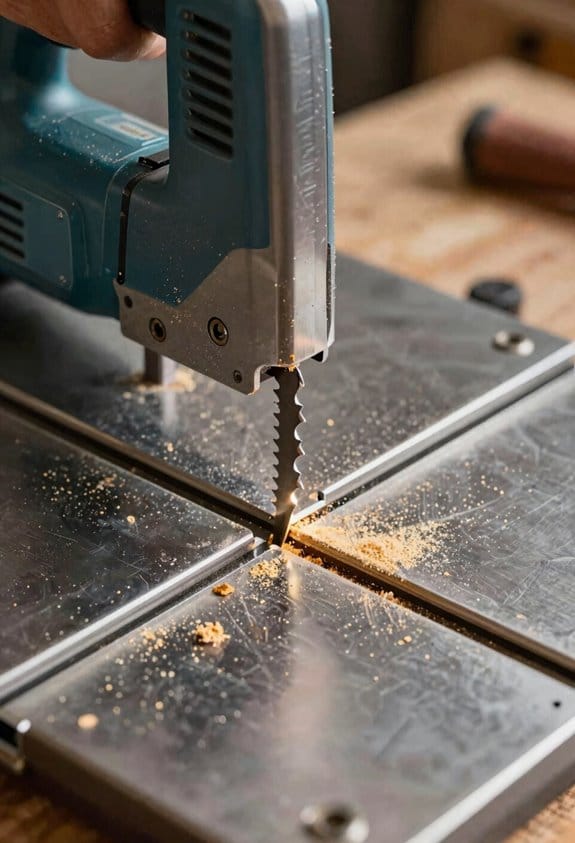
Before you choose a blade, know why thin-kerf matters for battery and low-power saws. It lowers cutting resistance so your motor draws less current and your battery lasts longer.
Several thin-kerf blades remove about 25% less material than standard blades. For example, a 24-tooth 7-1/4″ thin-kerf blade with a 0.060″ kerf will cut the same board while ejecting roughly a quarter less sawdust than a 0.080″ kerf standard blade. That smaller cut reduces torque demand, which helps your saw keep RPM when you hit a knot.
Why that matters: less resistance means less heat and less chance your small motor hits thermal cutout. Picture cutting a 2×8 pine with a compact circular saw on a summer day; a thin-kerf blade will let you complete more cuts before the motor temps climb and trigger protection. It’s a clear, practical difference.
How thin-kerf helps torque management:
- Lower force needed: the blade removes less material, so your motor needs less torque to sustain RPM.
- Smoother speed through trouble spots: when you cut across a knot or against the grain, the motor only drops a few hundred RPM instead of stalling.
- Reduced stalls and longer tool life: fewer stalls mean less stress on the motor and gears.
Real example: using a 6-1/2″ cordless jobsite saw on oak, swapping from a 0.085″ kerf blade to a 0.060″ kerf blade kept the saw from bogging down on crosscuts and let me finish a 12-board rip without swapping batteries.
Practical steps you can take:
- Match blade specs: choose thin-kerf blades rated for your saw’s RPM and arbor size.
- Monitor battery/gearbox temps: check the battery housing after 10 heavy cuts; if it’s hot to the touch, rest the tool.
- Avoid overloading: on dense hardwoods, take shallower passes—cut at half the depth in two passes if the motor struggles.
- Keep blades sharp: a dull thin-kerf blade raises current draw quickly.
One final concrete tip: if your saw’s spec calls for no less than 0.070″ kerf, don’t use a 0.050″ blade even if it fits; follow the manufacturer’s minimum.
Recommended Products
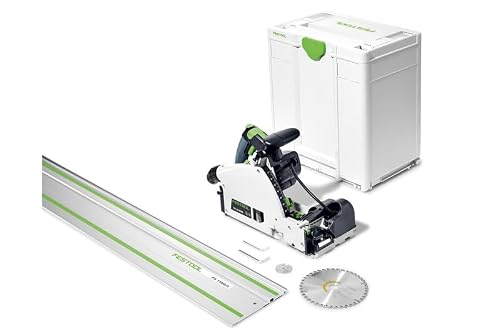
Splinter-free in a single cut. The perfect cut in a portable format. The TSV 60 K has a built-in scoring blade that can be adjusted with precision. Perfect cuts are practically guaranteed with zero-tearout—on both sides. With the TSV 60 K, the first cut is the final cut!

When used with Festool guide rails, you can achieve perfectly straight and splinter-free cuts.

Splinter-free: The scoring blades ensures splinter-free cuts on both sides from the very first cut.
When Thin-Kerf Improves Speed and Surface Finish
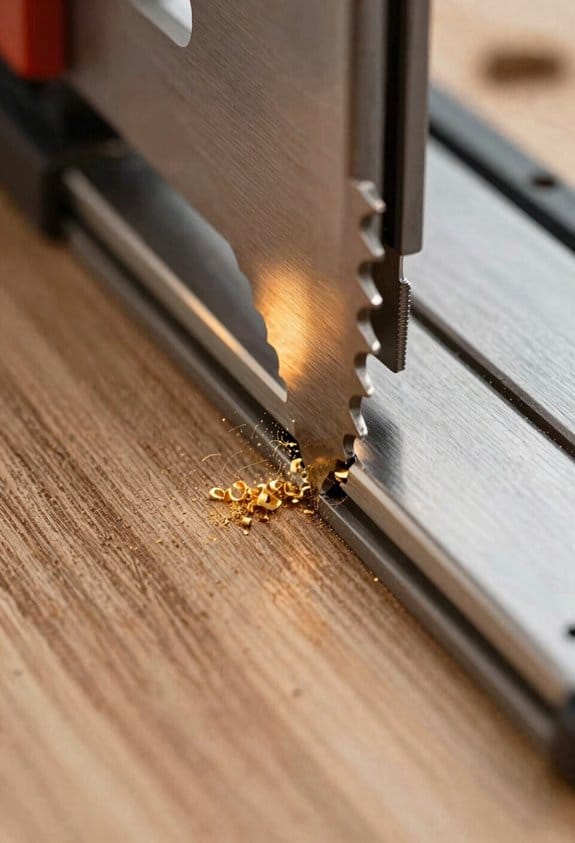
Think of thin-kerf blades like a lighter pair of running shoes: they save energy so you can go faster with less effort.
Why this matters: lower cutting resistance means your saw keeps RPM under load, so cuts finish quicker and with less heat. For example, on a 10-inch cordless table saw cutting 3/4-inch pine plywood, a thin-kerf blade (about 0.08–0.095-inch kerf) kept RPM within 200–300 of no-load speed, shaving 20–30% off cut time versus a 0.125-inch kerf blade and leaving fewer scorch marks.
How thin-kerf speeds up cuts and improves finish
Why this matters: reduced material removal per tooth cuts friction and vibration.
1) Less material per pass reduces load on the motor, so RPM stays higher.
2) Lower load means less heat at the tooth edge, so carbide teeth don’t gum or burn the wood.
3) Less vibration helps teeth enter wood cleanly, producing a smoother face.
Real example: ripping 8/4 cedar on a benchtop saw with a 60-tooth thin-kerf blade produced cleaner edges and required one fewer sanding pass than a standard kerf blade.
When thin-kerf won’t help
Why this matters: you can waste time or ruin stock if you pick the wrong blade.
- Don’t use thin-kerf on wide, twisted, or cross-grain cuts where the blade can bind; rigidity is the trade-off.
- Avoid thin-kerf on machines with loose bearings or wobble; blade deflection causes tearout.
Real example: using a 0.08-inch kerf blade on an older contractor saw with play in the arbor led to visible scalloping on 3/4-inch oak.
Practical steps to get the gains
Why this matters: follow steps and you’ll actually see faster cuts and better surfaces.
1) Check saw alignment and bearings; tighten or replace anything with play.
2) Choose a thin-kerf blade sized to your saw: 10-inch or 12-inch, kerf 0.08–0.095 inch for most cordless/tabletop use.
3) Match tooth count to the cut: 24–30 teeth for ripping, 40–60 for crosscut or plywood, 60–80 for fine finish work.
4) Run a test cut on scrap at your planned feed speed and listen for bogging; if RPM drops more than ~500 rpm, slow down or switch blades.
5) Sand or finish less: expect one fewer light sanding pass on softwoods and straight-grain hardwoods.
Real example: on a compact jobsite mitre saw, swapping to a 40-tooth thin-kerf blade cut 2x pine faster and left edges that needed only 80-grit sanding instead of 60.
Quick decision guide
Why this matters: makes choosing simple on the job.
- Use thin-kerf when: you’re cutting straight-grain or softwoods, speed matters, your saw is rigid, and you want a smoother surface.
- Skip thin-kerf when: stock is twisted, cuts are wide or cross-grain, your saw has loose alignment, or you need extreme rigidity.
Example: for a cabinet face-frame in maple, pick thin-kerf plus 60–80 teeth; for a rough-cut live-edge slab, stick with a standard kerf.
Final practical tip: if your saw is battery-powered, start with a thin-kerf 40–60 tooth blade and test one board; measure RPM drop and inspect the cut edge under good light before committing to the whole job.
Recommended Products


20° Face Hook for easy feed
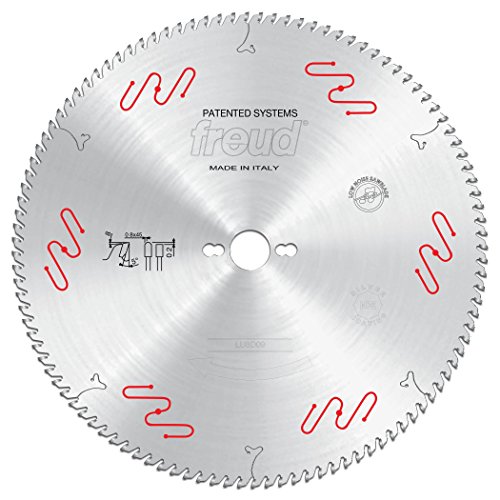
Specs: Arbor 30mm, Diameter 350mm, Grind TCG, Hook Angle 5°, Kerf 3.5mm, Pinholes 2/9/46.4 + 2/10/60, Plate 2.5mm, Teeth 108
When Thin-Kerf Struggles: Durability, Stability, and Wood Types to Avoid
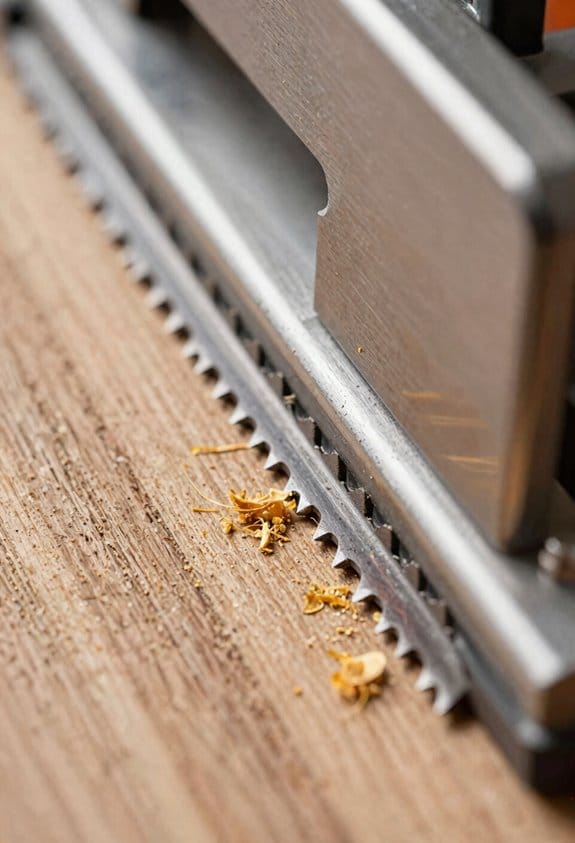
Before you pick a thin-kerf blade, you need to know where it struggles and why that matters: using the wrong blade can ruin a board or stall your saw.
Thin-kerf blades vibrate more because the steel plate is thinner and flexes under load, and that gets worse on dense hardwoods or when you hit a knot; you’ll feel chatter in the cut and see uneven edges. Example: cutting a 1 1/2″ maple board with a 0.045″ kerf blade often produces audible wobble and a fuzzy edge where the grain changes direction. Use a heavier plate (0.095″–0.125″) for that job.
Because the blade flexes, grain tearout is more likely on figured or cross-grain pieces, which hurts finish-critical joinery. If you’re making a dovetail or a face-miter on curly cherry, the thin blade can lift fibers and leave a ragged surface. Step 1: switch to a full-kerf 40–60 tooth finishing blade for those cuts. Step 2: score the cut line with a sharp knife when working with highly figured faces.
Thin kerf also wanders under lateral forces and that hurts squareness when you need tight tolerances; a blade that’s even 1/32″ off over a long rip can ruin a joint. Example: ripping a 24″ wide panel for a tabletop with a thin blade can drift enough to make two boards not match at the seam. If you need straightness under 0.020″, use a full-kerf blade and keep the fence firmly clamped.
For these practical situations, avoid thin blades:
- Knotted timber (a single knot can deflect the blade).
- Oily exotics like ipe or cocobolo, which heat and gum up thin gullets.
- Heavy ripping where your saw motor is under 3 HP and gets loaded down.
If your goal is speed and less waste but you still face tough woods, here’s a simple rule: use thin-kerf (around 0.060″ or less) for crosscuts, plywood, and light ripping on softwoods; use full-kerf (0.095″–0.125″) for dense woods, long rips, and finish work where square and tearout matter.
A quick checklist before you cut:
- Check blade plate thickness and pick ≥0.095″ for dense or knotted stock.
- Match tooth count to the cut: 24–30T for ripping, 40–60T for finishing.
- If you see vibration, stop and change blades or reduce feed speed.
If you follow those steps, you’ll save boards and avoid the frustration of blown cuts.
Which to Choose: Thin-Kerf or Full-Kerf for Your Saw and Project?
The difference between thin-kerf and full-kerf comes down to how much your saw has to work and how rigid the cut needs to be.
If your saw has limited torque or you use cordless tools, choose thin-kerf because it cuts with less resistance, saves material, and extends battery life. Why this matters: less resistance means fewer stall moments and longer run time per charge. Example: on a 18V brushless miter saw cutting 3/4″ oak plywood, a 0.095″ thin-kerf blade will finish a stack of six sheets with one battery more often than a 0.125″ full-kerf blade. Steps to use thin-kerf successfully:
- Pick a high-quality thin-kerf blade (0.095″–0.110″) with carbide teeth.
- Use a zero-clearance insert to reduce tear-out.
- Feed at a steady pace—don’t force the blade.
Outcome: less power draw and saved material.
Before you select full-kerf, understand why rigidity matters in joinery and long rip cuts. Full-kerf gives stability and straighter cuts, which matters when you’re prepping boards for gluing or cutting long hardwood rips. Example: when ripping a 6′ maple tabletop blank on a cabinet table saw, a 0.125″ full-kerf blade will flex less and give a straighter edge than a thin-kerf under the same fence pressure. Steps to use full-kerf without overtaxing your saw:
- Ensure your saw motor has at least 1.5–2.0 HP (for benchtop table saws) or use a contractor/cabinet saw.
- Use blade stabilizers or a riving knife if available.
- Keep feeds steady; back off if the motor bogs.
Outcome: cleaner joints and less post-joint sanding.
Consider blade tuning and noise/vibration control because wobble and sound affect cut quality and comfort. Why this matters: a wobbling blade ruins finish and can be dangerous. Example: replacing a warped blade with a properly trued blade reduced vibration on my jobsite chop saw and cut wobble by half. Steps to minimize wobble and noise:
- Inspect blade for warps and replace if runout > 0.005″ at the arbor.
- Clean pitch and resin from the blade with a citrus-based cleaner every 20–30 hours of cutting.
- Use isolation pads under the saw and tighten arbor nuts to manufacturers’ torque (usually 25–40 ft-lbs depending on saw).
Outcome: less vibration, lower noise, and straighter cuts.
Match blade choice to material, motor capacity, and finish needs because the right combination prevents frustration and rework. Example: for plywood veneer work with a 1.25 HP table saw, use a 0.095″ thin-kerf 80-tooth crosscut blade; for solid cherry ripping on a 2 HP cabinet saw, use a 0.125″ full-kerf 40-tooth ripping blade. Steps to choose:
- Identify your motor power and material hardness.
- If motor < 1.5 HP or you’re on a cordless saw, default to thin-kerf.
- If you need glue-up accuracy or are ripping long hardwoods, choose full-kerf.
Outcome: consistent cuts and fewer wasted boards.
Recommended Products
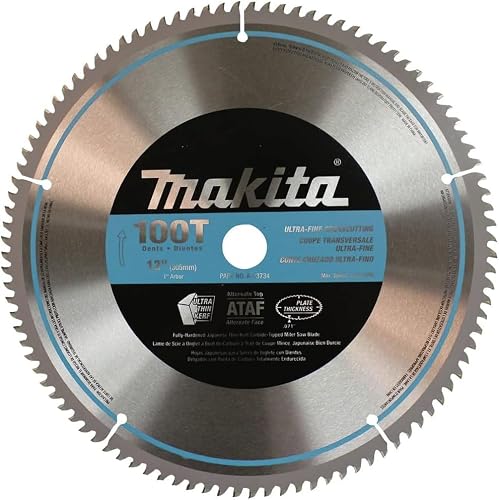
The information below is per-pack only

Guide rail not included (available separately).

RIPCROSS VERSATILE BLADE: Designed for precise, efficient cutting with a super smooth finish of plywood, composition board, and hard and soft woods. (Ripcross is a registered trademark).
Quick Checklist: When to Buy a Thin-Kerf Blade and How to Set It Up
Before you buy a thin-kerf blade, you need to know why it matters: thinner blades cut with less resistance, so your saw uses less power and you waste less wood.
Why it matters: thin-kerf blades let a weak motor finish cuts without bogging down. Example: on a 12″ jobsite saw with a 1.25 hp motor, switching from a 0.120″ kerf blade to a 0.090″ kerf blade kept the blade spinning through 2x framing studs without tripping the breaker.
1) When should you buy one?
- If your motor struggles under load. If your saw bogs down, stalls, or trips at the start of a rip, get a thin-kerf blade (kerf ~0.080–0.095″).
- If material is expensive or scarce. For 8/4 walnut or antique boards, a 0.090″ kerf saves noticeable material on long rip cuts.
- If you need longer battery life on cordless tools. A thin-kerf blade on a 6-1/2″ cordless circular saw can extend a battery by about 10–20% on a full day of cuts.
Example: cutting twelve 8′ poplar boards for trim—using a 0.090″ kerf instead of 0.120″ kept you from wasting roughly 1.5″ of total board width across the run.
Before you buy, check compatibility: measure your arbor, read the blade RPM rating, and pick an appropriate tooth count for the job. Mismatches reduce safety and cut quality.
Why setup matters: a poorly mounted thin blade will wobble, burn wood, or kick back.
2) How to set up the blade safely
Why it matters: correct setup prevents wobble and tear-out, and keeps you safe while cutting.
Example: ripping a 8′ pine stud on a jobsite table saw—if the blade is loose by one flat of the wrench, you’ll feel vibration on the fence and get a ragged edge after the first 12″ of cut.
Steps:
- Verify the blade matches your saw: arbor hole and RPM.
- Remove the old blade and clean the flange faces with a rag.
- Install the thin-kerf blade with teeth pointing toward the feed direction.
- Tighten the arbor nut to the manufacturer torque spec. If there’s no spec, tighten to the snug setting on the wrench, then add a quarter-turn.
- Check fence alignment: use a combination square to ensure the fence is parallel to the blade at the table surface within 1/32″.
- Set blade height so the top of the teeth sticks about 1/8″–1/4″ above the board for rips, and 1/4″–1/2″ for crosscuts.
- Run a test cut on scrap: look for wobble, listen for chatter, and check the cut face for burn marks.
- If you see tear-out, slightly adjust the fence or reduce feed speed.
Use a physical example: test cut a 12″ length of the same lumber you’ll use on the project and measure the kerf width and finish quality before cutting your actual pieces.
When to swap back
Why it matters: thin-kerf blades aren’t ideal for every job, and using the wrong blade wastes time and damages work.
Example: when cutting hardwood trim or doing finish joinery on maple, the thin blade may flex and cause fuzz or inconsistent profiles.
Steps:
- For hardwoods or fine joinery, install a full-kerf blade (kerf ~0.110–0.140″) with an appropriate tooth count (e.g., 60–80 T for finish crosscuts).
- Re-check fence and blade alignment after swapping.
- Run a scrap cut to confirm clean edges and no vibration.
Quick checklist (three items):
- Motor struggles? Buy thin-kerf (~0.080–0.095″).
- Lumber is costly? Thin-kerf saves material.
- Doing hardwoods or finish work? Use full-kerf and higher tooth count.
Final tip: always test on scrap, and use the blade the way it was rated—don’t exceed the RPM stamped on the blade.
Recommended Products

The unique KickbackStop helps to reduce the risk of kickback during sawing or plunge-cutting into the workpiece.

Guide Rail sold separately.

Guide Rail sold separately.
Frequently Asked Questions
Do Thin-Kerf Blades Require Different Blade Guards or Safety Adjustments?
Yes — I recommend checking blade guard fit and making safety adjustments when using thin-kerf blades; I’ll make certain the guard clears narrower carbide teeth, adjust riving knife alignment, and confirm anti-kickback devices function properly.
How Does Thin-Kerf Affect Resawing or Cutting Very Thick Lumber?
Like a tightrope act, I’d say thin-kerf improves resaw efficiency on thinner stock but struggles with thickness limitations: it deflects, wanders and overheats on very thick or knotted lumber, so I avoid heavy resawing.
Are Thin-Kerf Blades More Expensive to Sharpen or Maintain?
No — thin-kerf blades generally don’t demand higher cost; I find professional sharpening? only slightly pricier because carbide teeth and thinner bodies need careful setup, but routine maintenance costs are comparable to full-kerf blades.
Can Thin-Kerf Blades Be Used on Miter Saws and Chop Saws Safely?
Yes — I use thin-kerf blades on miter saws and chop saws if miter compatibility is confirmed; I follow safety practices: proper blade seating, lower RPM limits, firm clamps, slow feed, and avoid hard knotty hardwoods to prevent wobble.
Do Thin-Kerf Blades Increase Risk of Kickback Compared to Full-Kerf?
Once in a blue moon I’d say yes—thin-kerf blades can raise kickback risk if blade balance or fence alignment aren’t perfect; I’d tighten setup, use anti-kickback measures, and avoid stressed hardwoods to stay safe.