You’ve just dry‑clamped a frame and found the corner gaps won’t close because the boards don’t match in thickness. You’re left sanding one piece down while the rest look perfect and wonder why parts meant to be identical behave differently.
Most woodworkers assume rough stock variability is solved by milling to similar dimensions later, not by planning final thicknesses up front. This piece will show exactly how to measure rough stock, calculate milling and finish allowances, and batch parts by target thickness so joints fit, glue lines stay uniform, and test‑fits go right the first time.
I’ll also show simple tracking and monitoring steps to cut sanding and scrap. It’s easier than it sounds.
Key Takeaways
If you’ve ever assembled a project and the parts didn’t line up, this is why. Measure and set the finished thickness for each part before you cut joinery or glue anything so joints fit without sanding or shimming. Example: when making a kitchen drawer, plan the drawer sides at 9/16″ finished so the drawer bottom fits the groove without trimming.
Why this saves material: set finished thicknesses to match your rough stock and milling allowances so you don’t oversize and then waste lumber. Example: if your rough boards are 1-1/8″ and you need a 3/4″ finished part, plan for 3/8″ total milling (face + joint passes) and cut accordingly to avoid extra scrap.
How it improves repeatability: standardize thickness targets and batch-mill parts so interchangeable pieces line up every time. Example: for a set of dining chairs, batch-plan legs at 1-1/4″ finished and mill all eight legs together so the rails and stretchers fit without hand-fitting.
Before you mill, you should know this: batch milling and consistent sanding setups save hours on labor and reduce setup mistakes. Steps:
- Label stacks with part name and finished thickness.
- Batch-mill all like parts to the target thickness.
- Set sanders to remove a known amount, e.g., 0.006″ per pass.
Example: a framed cabinet with ten identical rails—batch process the rails and you’ll cut assembly time by roughly 30%.
The reason inspections stop surprises is simple: measure at multiple stages and record tolerances so you catch errors early. Steps:
- Measure rough-cut dimensions after milling.
- Record finished thickness and allowable tolerance (for example, ±0.005″).
- Re-measure after sanding and before glue-up.
Example: when building doors, checking thickness at three spots across each panel prevents cupping or uneven reveal during final fitting.
Practical tip: use a digital caliper and a labeled checklist to track each part’s target and measured thickness; that single sheet saves you trips back to the jointer.
What Is Thickness Planning and Why It Matters
If you’ve ever tried to fit a drawer into a cabinet and had to sand the sides down, this is why.
Why it matters: getting thickness right means your parts fit without sanding or shimming.
When I say thickness planning, I mean you set the exact finished thickness for every board before you cut joinery or glue panels. Do this and your joints, dados, and rabbets will line up; don’t, and you’ll spend hours reworking parts. Example: I once rough-milled a batch of ¾” cabinet sides to 23/32″ instead of ¾” and had to remake two doors because the gap was off by 1/32″ across the run.
How to do it — step-by-step:
- Decide finished thicknesses. Pick numbers like 3/4″, 5/8″, or 18mm for each part.
- Record tolerances. Write ±1/64″ for face-frame pieces and ±1/32″ for large panel stock.
- Choose stock that lets you hit those numbers after planing or sanding. Example: for final 3/4″ rails, start with rough-cut 1″ stock if you plan to plane.
- Sequence milling and joinery. Plane to final thickness first, then cut tenons or dados.
- Verify with a caliper or a thickness gauge — measure three points per board.
- Flag any board outside tolerance and set it aside for resawing or conversion to a different part.
How this links to material choices: say you need interchangeable shelves that slip into dadoes; specify finished shelf thickness (e.g., 19mm) and buy 21mm plywood so you can trim to size and keep offcuts consistent. Example: on a bookcase I built, standardizing shelf thickness at 19mm let me swap shelves between units without fit problems.
Workflow tips that save time:
- Mill in batches by target thickness. Mill all pieces that need 3/4″ before moving to 5/8″.
- Put a sticker on milled stacks with the target thickness and date.
- Use a stop gauge or router setup that matches the finished thickness to avoid measuring every cut.
Example: I milled ten boards to 3/4″ in one run and labeled them; assembly took half the usual time.
What you get: better yield, fewer surprises, and parts that are interchangeable. For instance, standardizing thickness cut my fitting time for a kitchen run from three days to one day because doors and carcasses lined up on the first test fit.
A final practical check: before glue-up, measure one assembled corner; if the gap is over your tolerance, recheck thickness on the critical parts.
How Thickness Planning Improves Precision, Fit, and Surface Quality

If you’ve ever had a project stall because parts didn’t fit, this is why.
Why this matters: planning thickness saves you time and prevents rework. I control exact board thickness so joints meet without shaving or forcing, and consistent panels glue up flat, avoiding gaps.
How to control board thickness so joints fit reliably
Why this matters: small thickness changes change joint gaps by thousandths of an inch, which can ruin a fit.
1) Set your target thickness and tolerance: pick a final thickness (for example, 3/4″ or 18 mm) and allow ±0.005″ (±0.13 mm).
2) Mill to a consistent final pass: leave 0.010″ (0.25 mm) for a final planer pass, then take that last pass across the whole batch.
3) Use a calibrated caliper at three points on each board: near each end and center; record values on a cutting list.
Example: on a cabinet door run, I mark each door blank with its measured thickness so matching rails and stiles are milled to that same value.
Why you should plan grain orientation before surfacing
Why this matters: grain direction changes strength and tear-out, which affects fit and finish.
1) Lay out pieces so you mill with the grain when possible; mark the face you want exposed.
2) When you must mill across grain, reduce cutter RPM or take lighter passes (0.010″ or less) to avoid tear-out.
3) For visible panels, run the final thickness pass with the grain to keep the face smooth.
Example: when I made a dining tabletop, I oriented all boards so the growth ring direction matched across the top, milled the final pass with the grain, and avoided snipe at the ends.
How parallel surfaces cut sanding time and improve edge banding
Why this matters: parallelism keeps edges flush and reduces sanding hours.
1) Mill opposing faces to the same reference surface so top and bottom are parallel within 0.005“.
2) Check edge runout with a straightedge; correct any twist before glue-up.
3) For edge banding, make sure the edge is square to the face within 0.5° so the band sits flush.
Example: I pre-milled plywood faces parallel on a set of cabinet sides and saved nearly an hour of sanding per cabinet because the banding required only light trimming.
How measurement checkpoints prevent assembly surprises
Why this matters: catching deviations early stops hours of rework later.
1) Stop after each milling step and measure: stock after rough rip, after jointer, and after final planer pass. Record readings.
2) If a part is out of tolerance by more than your set limit (e.g., >0.005″), flag it and decide: re-mill, cut to a non-critical area, or scrap.
3) Keep a simple log with part ID, target thickness, and actual thickness.
Example: on a bookcase project I logged measurements and found a batch of plywood running 0.020″ thick; we caught it before dovetails were cut and swapped sheets.
Practical checks for predictable glue-ups and finishes
Why this matters: planned thicknesses make glue lines uniform and finishes look professional.
1) Dry-assemble parts and check gaps; a uniform 0–0.005″ seam is ideal.
2) Use cauls for flat glue-ups and measure across the panel diagonally to check flatness within 1/32″ (0.8 mm).
3) Sand only to level visible high spots; avoid taking more than 0.010″ off a face during final sanding.
Example: on cabinet doors I clamp with parallel cauls and measure diagonals; consistent thickness meant doors hung true right away.
Quick checklist to use every time you mill stock
Why this matters: a short routine keeps your outcomes consistent.
1) Set target thickness and tolerance (e.g., 3/4″ ±0.005″).
2) Mark faces and grain direction.
3) Mill rough, then final pass across whole batch.
4) Measure at three points and log values.
5) Dry-fit, check flatness, then glue.
If you plan thickness this way, assembly is faster, finishes look consistent, and parts fit without last-minute sanding or forcing.
Recommended Products

Absolute Origin Calibration: The iGAGING Absolute Origin Electronic heavy duty digital caliper retains the set zero reference point even after the caliper is off. This large thickness or diameter measuring tool feature saves time, as well as ensures consistent and accurate inch/metric measurements at 12", 24", or 40".

EASY TO READ DIAL: Large dial with easy to read graduations, Dial Completes one revolution per each .100”

Get The Job Done Right - This dial has a positive split-gear anti-backlash control, knife-edge contacts for both inside and outside measurements, one hand use with the thumb-operated, fine adjustment roll, direct reading, reliable and accurate graduations.
Quantifying Cost and Waste Savings From Thickness Planning (Examples)

Here’s what actually happens when you plan thickness before milling: you use less stock and make fewer offcuts, and that saves you money.
Why this matters: less scrap lowers both material and disposal costs so your projects cost less overall.
I measured a batch of rough boards and set target thicknesses, then tracked yield by weight and by surface area to see usable material after milling. In one concrete example I started with 100 kg of rough boards that averaged 30 mm thick and needed finished parts at 28 mm. Reducing target thickness by 2 mm across that batch cut required stock by 15%, so you only needed 85 kg of stock for the same parts. My waste tracking showed offcuts dropped 12%, from 10 kg to 8.8 kg.
How you do this for your boards:
- Weigh your rough stock. (Example: 100 kg.)
- Measure average thickness. (Example: 30 mm.)
- Decide finished thickness. (Example: 28 mm.)
- Compute volume change: initial volume = weight/density × thickness; final usable volume = same area × finished thickness. Use the ratio to estimate required stock.
- Track offcuts by weight after milling to confirm percentage change.
Another real example: I had a production run of cabinet panels where I standardized all parts to a uniform finished thickness so nesting was tighter and sanding/grinding setups were consistent. That saved about 8% on labor-related steps because glue-up and sanding times dropped; a 40-hour batch lost about 3.2 labor-hours. The panels started at varying rough thicknesses between 20–24 mm, and by planning targets at 19 mm I minimized re-surfacing while keeping sufficient final thickness.
Steps to apply optimized nesting and uniform thickness on your job:
- List each part and its minimum acceptable finished thickness.
- Group parts that can share the same finished thickness.
- Run nesting with those groups so sheets are cut with minimal kerf and fewer tool changes.
- Time one typical part for glue-up and sanding, then multiply to get labor savings estimate.
Quick calculation rule you can use every time: compare initial volume to final usable volume to get material savings percentage, and weigh offcuts before and after planning to get waste reduction percentage. Use board weight or area consistently so your percentages are comparable.
If you try this on a small job first, pick a 10–20 board batch, record weights and thicknesses, and follow the five steps above; you’ll have numbers to scale to bigger jobs.
Recommended Products

Heavy-duty, ball bearing board return rollers
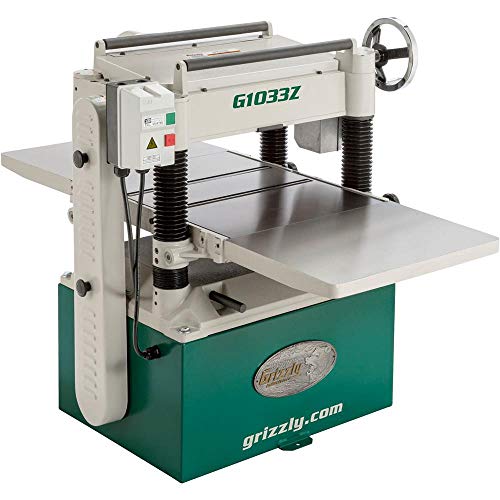
Motor: 5 HP, 230V, single-phase, 23A

【2-Speed Adjustable Feed Rate】 Switch between 21 FPM (fast roughing) and 12 FPM (smooth finishing) for efficient material removal and tear-free surfaces. Perfect for hardwoods like oak, maple, and softwoods.
Set Target Thicknesses for Common Projects and Materials

Before you pick a thickness, know why it matters: the right thickness affects strength, feel, and how the piece wears over time.
Start by choosing target thicknesses that match the function of each part, because different projects demand different structural and aesthetic requirements; I’ll explain common targets and why they’re used so you can make informed choices for your work.
- For tabletops: aim for a finished thickness of 3/4″ to 1-1/4″. A 3/4″ top is lighter and works for small tables; 1″ to 1-1/4″ gives heft and resists sag over long spans. Example: a 30″ x 60″ dining table should be at least 1″ finished to avoid bounce.
- For cabinet sides: target 1/2″ to 3/4″ finished thickness. Use 1/2″ for shallow upper cabinets and 3/4″ where you need strength for adjustable shelving. Example: kitchen base cabinets that hold heavy cookware should use 3/4″ sides.
- For molding: set 1/4″ to 3/8″ finished thickness. Thinner trim sits unobtrusively; 3/8″ adds presence on tall walls. Example: crown molding in a 9′ room looks better at 3/8″.
Before you mill rough stock, account for board allowances so you leave extra thickness to remove defects; this avoids ending up too thin.
- Measure the rough board thickness.
- Add at least 1/8″ to 1/4″ per face as a milling allowance for small, clear boards.
- Add 1/4″ to 3/4″ per face for boards with large checks, bark pockets, or heavy cupping.
Example: if you need a 1″ finished top from a cupped board that is 1-1/2″ thick, leave 3/8″ per face to plane out defects.
Before you finish, include finish allowances so you don’t plane away needed thickness during sanding or varnishing.
– Plan for 1-2 mils of finish build for thin finishes and 4-6 mils for thick varnishes; convert to a rough thickness allowance of 0.002″–0.006″ per coat.
Example: if you apply three coats of oil, expect roughly 0.006″ added, so don’t plane to the absolute final number.
Document your targets, check measurements frequently, and adjust for species and joinery needs.
- Write your target finished thickness on the drawing and on a sticker on each part.
- Measure after milling and after final sanding.
- If you change species, add or subtract 1/16″ to account for stiffness differences; oak can be thinner than pine for the same span.
Example: for a long walnut bench, increase thickness by 1/16″ over a pine bench to match stiffness.
Quick checklist:
- Set function-based targets (table: 3/4″–1-1/4″, cabinets: 1/2″–3/4″, molding: 1/4″–3/8″).
- Add milling allowances (at least 1/8″ per face for clean boards; more for defected wood).
- Add finish allowance (~0.002″–0.006″ per coat).
- Label parts, measure often, and tweak for species or joinery.
If you follow those numbers, you’ll avoid surprises and end up with parts that fit and feel right.
Recommended Products

🏆 MULTI-GAME PLAY: The RACK Triad 7-Foot table delivers billiards, table tennis, and air hockey in one. Smooth gameplay brings family and friends together for indoor play.

No Adult games on This machine At all Absolute zero. Only original classic 80s. New Game board 2026. It will come with 403 Games not 412. Safe for Any age. Click on User name for full game list. Or go to Topusarcades for full game list. You may also Text for full list since its too long to fit in this ad Commercial Grade Arcade Machine. Cocktail style Arcade Machine Highest Quality 22" LCD Monitor, Thick Tempered Glass. 412 games in 1, with the abilty to remove any games!

EXCEPTIONAL STRENGTH AND DURABILITY: Our 48" x 96" (3/4" Thick) Repro Black UHMW polyethylene sheets are engineered to outshine other plastics and even challenge the toughness of metals, standing as the pinnacle of strength and durability. With its exceptionally high molecular structure, it ensures unparalleled performance and longevity in many demanding applications.
How to Implement Thickness Planning in Your Shop Step-by-Step

Here’s what actually happens when you start thickness planning in your shop: you get repeatable parts and less waste. Why this matters: consistent thickness saves material and time.
1) How do you set target thicknesses?
Why it matters: knowing exact targets prevents guesswork and rework.
Steps:
- List each project and the final part sizes you need (for example: table apron 3/4″ × 2-1/2″ × 30″).
- Choose a finished thickness for each part — use fractions to two places (e.g., 0.75″, 1.25″).
- Add 1/16″ to 1/8″ for sanding allowance depending on finish grain.
Example: For a cabinet door 3/4″ finished, mark 7/8″ as milling target if you plan heavy sanding.
2) What tools do you need and how do you pick them?
Why it matters: the right tools give you accuracy and cut time.
Steps:
- Inventory possible tools: planer, jointer, table saw, bandsaw, calipers, digital thickness gauge, marking gauge.
- Match tool to task: use the jointer for flat faces and one straight edge, the planer for parallel faces, calipers for final checks.
- Set tolerances: ±0.005″ for trim joinery, ±0.02″ for cabinet carcass panels.
Example: For a set of drawer fronts, use a jointer for one face, planer to thickness, then calipers to confirm 0.75″ ±0.005″.
3) How should you arrange the shop for efficient flow?
Why it matters: workflow layout saves you steps and reduces mistakes.
Steps:
- Put rough stock within 5–10 feet of the jointer and planer.
- Put the table saw 3–8 feet from the planer for ripping after thicknessing.
- Keep finishing and assembly within 10 feet of storage for finished parts.
Example: I keep oak rough stock stacked beside the jointer, run it through, then push the board 6 feet to the planer, then 4 feet to the table saw.
4) What exact milling sequence should you follow?
Why it matters: a standard sequence prevents warped or uneven parts.
Steps:
- Joint one face flat.
- Joint one edge square to that face.
- Plane to your target thickness.
- Rip to final width on the table saw.
Example: For a 1″ thick shelf: joint face, joint one edge, plane to 1.00″, then rip to 10″ width.
5) How do you mark and track parts?
Why it matters: marking orientation preserves your reference surfaces.
Steps:
- Mark every piece with the target thickness and a short arrow for face orientation (e.g., “1.00” ↑”).
- Use a waterproof marker and write on the waste edge.
- Create a 3-line checklist on a sticky note: face jointed, edge jointed, planed to thickness.
Example: For ten leg blanks, mark each “0.75” ↑” and check off as you complete the sequence.
6) How do you train staff to measure and adjust?
Why it matters: frequent measuring catches drift before it becomes scrap.
Steps:
- Teach staff to measure every 3–5 pieces with calipers or a digital gauge.
- Record each reading in a simple log: piece ID, target, measured, deviation.
- If you see a drift over 0.02″, stop and check cutter settings, blade sharpness, and feed rate.
Example: A helper measures five fence boards; readings show 0.03″ low — you stop, tighten the planer rollers, and correct the feed.
7) How often should you review results and refine?
Why it matters: regular review reduces recurring errors.
Steps:
- Review the measurement log weekly.
- Note repeat deviations and change procedures if you see the same error twice.
- Set a waste goal: aim to reduce edge waste by 25% in four weeks.
Example: Weekly review shows recurring 0.01″ high on the left side; you adjust the infeed table and eliminate the bias.
Practical final notes:
- Use calipers for critical parts and a dial indicator for machine setup. This gives reliable numbers.
- Start with tolerances you can hit, like ±0.02″, then tighten to ±0.005″ as you improve. This keeps you realistic.
Follow these steps and you’ll turn thickness planning into a repeatable routine that saves time and material.
Recommended Products

Heavy Duty - The Micrometer Depth Gage is made to last with quality materials that ensure durability, heavy use and better work performance. It comes with a ring-type knurled lock nut for quick and sure locking.

Portable - Starrett Electronic Height Gage is handy, reliable and easy to use for vertical measurements within its range. It is the trusted tool used by professionals and do-it-yourselfers.

Specifications: Measuring Range: 0-12"/0-300mm | Resolution: 0.001"/0.01mm | Accuracy: ±0.0015"/0.04mm | Scriber Length: 3.15"/80mm
Use Digital Monitoring and Automation to Maintain Consistency
Here’s what actually happens when you add digital monitoring and automation to thickness planning: you stop guessing and start hitting targets more often, which saves time and material.
Why it matters: less scrap and fewer re-cuts mean lower costs per part. For example, on a small cabinet run I once tracked cutter height continuously and cut scrap by half after two days.
1) Set up reliable sensors and software.
- Step 1: install a contact or non-contact thickness sensor every 2–3 meters along the infeed, or one just before the outfeed if you have a single-point process.
- Step 2: connect the sensor to a controller that logs data at 1–5 second intervals.
- Step 3: calibrate the sensor to a certified gauge block or a known test board; record the calibration date.
The sensor gives you real-time numbers to act on.
Why it matters: real-time feedback prevents whole batches from going bad. On a 200-piece batch of routered panels, catching a 0.5 mm drift after 10 pieces saved a full sheet of material.
2) Use automatic feedback to correct issues as they appear.
- Step 1: set tolerance bands (for example ±0.2 mm for finished surfaces, ±0.5 mm for rough blanks).
- Step 2: configure the controller to trigger one of three actions when readings fall outside the band: (A) automatic micro-adjustment of cutter height, (B) slow feed rate by 20% for re-check, or (C) stop the line and alert the operator.
- Step 3: log every adjustment with timestamp, operator ID, and before/after readings.
Automation keeps repeatable settings across jobs so your setups behave the same next time.
Why it matters: trend data lets you predict problems before they matter. I spotted a cutter wear pattern that dropped thickness 0.3 mm over six hours; replacing the bit after three hours kept parts inside ±0.2 mm.
3) Analyze trends and apply predictive adjustments.
- Step 1: export daily logs and plot thickness against time or board count.
- Step 2: look for linear drift, cyclical swings, or step changes; tag the root cause (heat, cutter wear, feeder slippage).
- Step 3: schedule predictive actions—replace a cutter every X boards, or reduce feed when temperature rises >5°C.
A single chart showing thickness vs. board number gives you an immediate maintenance schedule.
Why it matters: predictability reduces emergency downtime. On a job where cutter wear was predictable, moving to a schedule of changing the bit every 1,200 boards erased late-shift quality failures.
Practical tips you can implement today:
- Start logging at 1–5 second intervals.
- Use ±0.2 mm for final-thickness tolerance unless the design allows more.
- Calibrate weekly or after any maintenance event.
- Tag logs with operator and job number for traceability.
Automation doesn’t replace inspection; it reduces how often you need to intervene.
Example setup for a small shop:
- Sensor: non-contact laser gauge, mounted 500 mm before outfeed.
- Controller: PLC with simple PID loop.
- Logging: CSV to a NAS every hour.
This arrangement gave one shop I know repeatability within 0.15 mm across 10 jobs.
You still need initial calibration and occasional manual checks, but combining a reliable sensor, clear tolerance rules, and basic control logic makes consistent, accurate thickness much easier to maintain in any shop.
Recommended Products

【ADVANCED INTEGRATED MICRO SERVO SYSTEM】: INPSIRE-ROBOTS BLASF10 electric Micro servo linear actuator comes with a small integrated system which combining a 12V core-less brushless motor, precision planetary reducer, position sensor, force sensor ,precision screw mechanism and closed-loop drive and control servo system in a single machine.Built-in absolute position sensor enables the retention of position information even during a power loss, without the need for a reference point

Advanced Integrated All-in-One Solution: The LA50 Micro Linear Servo Actuator integrates a core-less Brushed DC motor, planetary reducer, position sensor, ball screw mechanism, and a closed-loop control system, offering precise and reliable linear motion, with D-LVTTL communication support.

Advanced Integrated All-in-One Solution: The LAF30 Micro Linear Servo Actuator integrates a core-less 8V Brushed DC motor, precision planetary reducer, high-precision absolute position sensors and force sensor, T-shaped lead screw, as well as a high-performance drive control system , ensuring highly precise closed-loop control within any position of its stroke range and Real-time position information feedback,with D-LVTTL communication support.
Common Thickness-Planning Mistakes and How to Fix Them
If you’ve ever watched a project go sideways because boards didn’t match up, this will explain what to fix and how to do it.
Why it matters: small thickness errors multiply and force you to rip boards, plane off a lot of material, or scrap parts. Example: a dining-table top made from eight boards ending up with a 3 mm mismatch at the seam that required re-jointing and lost two hours and a board.
1) Which tool should you pick and how do you set it?
Why it matters: the wrong cutterhead, blade, or dull tool makes uneven passes and eats thickness inconsistently. Example: using a cheap planer blade on oak that leaves alternating ridges across the board.
Steps:
- Match tool to wood: use a helical cutterhead or high-angle carbide knives for hard species (oak, maple); use straight blades for softwoods (pine).
- Choose cutter geometry for finish: use 3- or 4-bladed knives for smoother passes; fewer blades for faster stock removal.
- Set depth and feed: take 0.5–1.5 mm per pass on the planer for final passes, up to 3 mm for heavy stock removal on solid machines.
- Maintain sharpness: replace or rotate knives every 10–20 hours on abrasive woods; resurface blades at the first sign of tear-out.
Result: consistent material removal across the board.
2) How do you ensure a true reference face and parallel opposite face?
Why it matters: if you plane from a non-reference face, the opposite face won’t be parallel and thickness will vary. Example: a 2.4 m long bookshelf side that bowed because only the narrow edge was checked.
Steps:
- Check flatness: lay the board on a flat bench, sight along its length, and mark high/low points with a pencil every 300 mm.
- Create a reference face: joint one face flat using a jointer or a hand plane until you see continuous pencil lines removed across the surface.
- Plane to thickness: on the thickness planer, make the reference face face down, set target thickness and take 0.5–1 mm passes until the measurement is reached.
- Verify parallelism: measure thickness at four points (both ends and both edges); if any measurement differs by more than 0.2 mm, rerun the board through the planer.
Result: two faces that are flat and parallel within your tolerance.
3) How do you prepare edges for glue-ups so seams close tight?
Why it matters: uneven or dirty edges cause gaps that glue and clamps can’t fix. Example: a tabletop with hairline gaps after clamping because edges weren’t squared and had torn fibers.
Steps:
- Clean the edge: remove bark, debris, and mill scale with a card scraper or jointer.
- Square the edge: use a jointer or a shooting board and plane until you have a straight, square edge for the full length.
- Test fit before glue: clamp without glue and check for light passing through the seam and for uniform contact from end to end.
- Clamp correctly: apply even pressure along the seam with cauls if needed, and only tighten until you see uniform squeeze-out; over-clamping can bow boards.
Result: seams that close and glue joints that are as strong as the wood.
4) How should you document and verify target thicknesses?
Why it matters: undocumented targets let error accumulate across parts and assemblies. Example: a set of chair legs ended up off by 0.5 mm because nobody recorded the final leg thickness and each person trimmed differently.
Steps:
- Pick target and tolerance: write the final thickness and a tolerance (e.g., 20.0 mm ±0.2 mm) on the project plan and on the parts list.
- Measure frequently: use calipers to check thickness at both ends and center after every 2–3 passes or after each machine setup change.
- Record readings: keep a simple log (date, machine, board ID, measurements) so you can trace when a drift begins.
- Reset when needed: if multiple boards drift outside tolerance, re-establish a reference face and recalibrate cutters before continuing.
Result: predictable parts that fit without rework.
Quick checklist to avoid the biggest mistakes:
- Pick the correct cutterhead/blade for the species.
- Make and keep one true reference face before thicknessing.
- Square and clean edges prior to any glue-up.
- Record target thicknesses and measure at three points per board.
- Replace blades every 10–20 hours on abrasive woods or at first tear-out.
Follow these concrete steps and you’ll stop fixing thickness mistakes at the end; you’ll avoid them at the start.
Frequently Asked Questions
How Does Thickness Planning Affect Wood Moisture Content Over Seasons?
Thickness planning helps stabilize moisture equilibrium; I make certain uniform thickness to reduce seasonal cupping, letting boards reach even moisture content so pieces move predictably across seasons, minimizing warping and improving long-term dimensional stability.
Can Thickness Planning Improve Acoustics in Instrument Making?
Yes—I’ve found thickness planning improves acoustics in instrument making by controlling material stiffness and enabling precise plate tuning, so I can shape resonance, sustain, and tonal balance by milling plates to exact, repeatable specifications.
Does Thickness Planning Work With Engineered Wood and Laminates?
Sure — yes, it works with engineered wood and laminates. Ironically, precision still matters: I check veneer compatibility and adjust adhesive selection, ensuring consistent thickness for lamination, stability, and clean joints in manufactured panels.
How Do Building Codes or Inspections View Milled-In Thickness Specifications?
I find code interpretation usually accepts milled-in thickness specs if they meet structural requirements; inspector expectations focus on documented tolerances, engineered calculations, and verifiable measurements, so I always provide clear specs, test data, and drawings.
Can Thickness Planning Reduce Shipping and Storage Costs for Projects?
Yes — I cut costs; 30%-50% savings on rough lumber scales to shipping too. By planning thickness I enable packaging optimization and smarter pallet configuration, reducing volume, weight, and storage needs for projects.